
The Wise Report Provides Government Updates for Areas of Interest to HGS Professionals.
Check out the Latest Wise Reports below...
Release Date: 18 April 2014
Release Date: 18 April 2014
Release Date: 7 April 2014
Release Date: 1 April 2014
Release Date: 1 April 2014
Release Date: 1 March 2014
Release Date: 1 March 2014
Release Date: 22 February 2014
Release Date: 16 February 2014
Release Date: 8 February 2014
Release Date: 2 February 2014
Release Date: 1 February 2014
Release Date: 1 February 2014
Release Date: 17 January 2014
Release Date: 1 January 2014
Release Date: 1 January 2014
Release Date: 21 December 2013
Release Date: 8 December 2013
Release Date: 2 December 2013
Release Date: 1 December 2013
Release Date: 1 December 2013
Release Date: 9 November 2013
Release Date: 4 November 2013
Release Date: 1 November 2013
Release Date: 1 November 2013
Release Date: 19 October 2013
Release Date: 5 October 2013
Release Date: 1 October 2013
Release Date: 1 October 2013
Release Date: 28 September 2013
The Houston Geological Society is powered by a community that cares.
Your donation supports students, technical programs, outreach, and the partnerships that strengthen our geoscience community. If HGS has helped you learn or connect, please consider giving back

Field Trip to Spindletop Museum in Beaumont
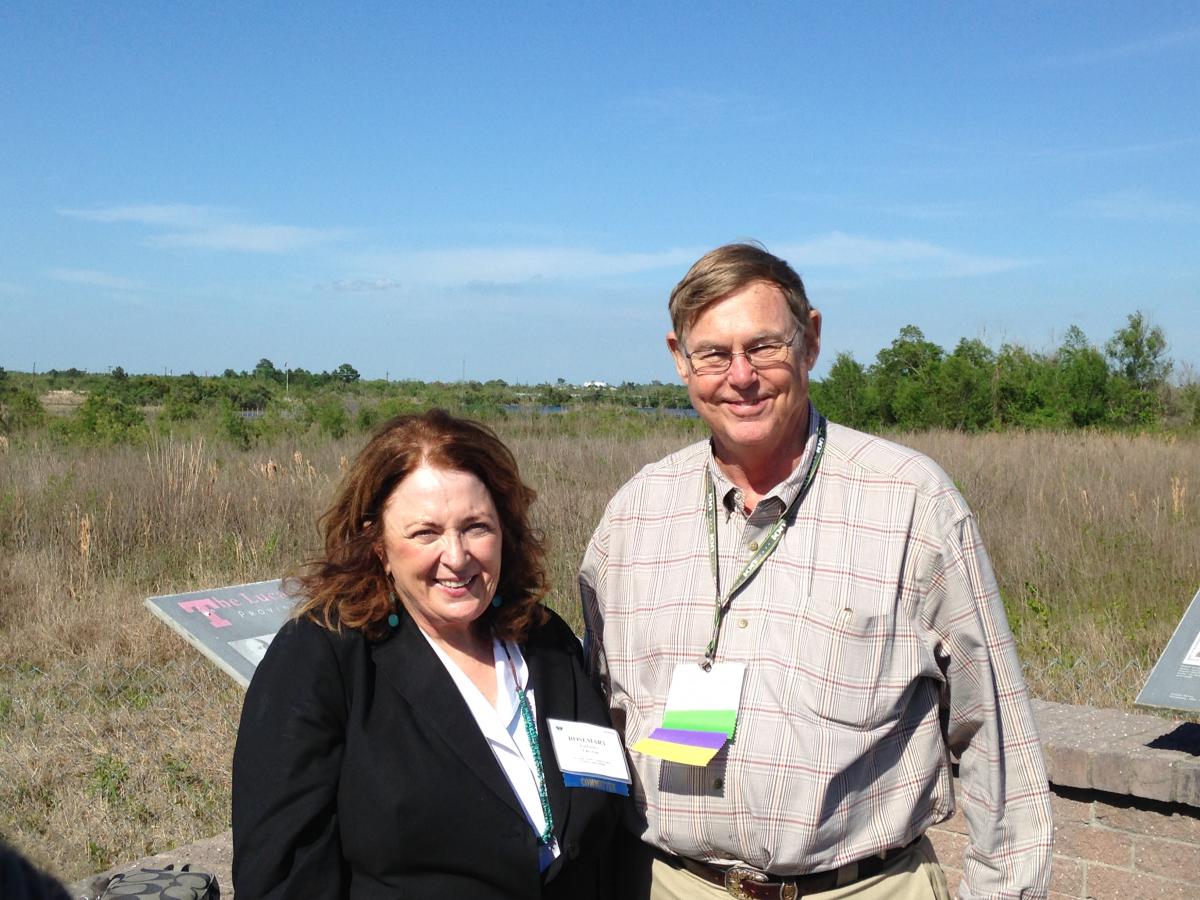
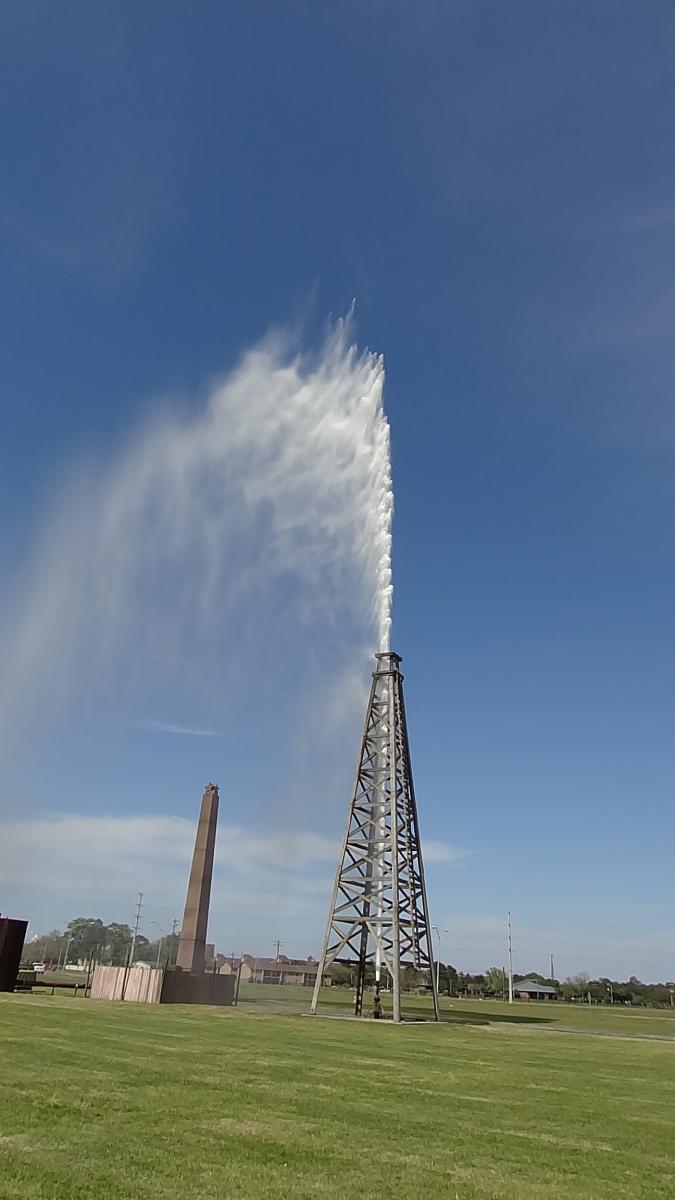
Photo taken looking at the site of the 1901 Spindletop blow out well.
Rosemary Laidacker and Robert Pledger organized an interesting field trip that took place after the AAPG Houston convention on Thursday, April 9. Forty-one geoscientists and history buffs traveled by bus to Beaumont, Texas, to see historical relicts of the early pioneer days of the oil industry.
The first stop was the Texas Energy Museum; at 600 Main Street, in Beaumont Texas , off I-10. During the drive, the group watched a video about the discovery of Spindletop oil , created for the 100th anniversary of the famous oil blowout on January 10, 1901. The Spindletop oil discovery is historically significant because it was the first US well to produce 100,000 barrels oil per day. The discovery ushered in new wealth, technology and rocketed the state of Texas to national prominence. The Texas Museum has two floors of displays relating to early Texas oil drilling, production and refining. The group was fascinated by the seismic line wall murals over the Spindletop Dome. More information is at www.texasenergymuseum.org.

Charles Sternbach, Linda Sternbach and Robert Pledger

The group then drove to the Gladys City Boomtown Museum on the campus of Lamar University in Beaumont. The Gladys City website is www.spindletop.org. Chairman of the Lamar Earth Science Department, Dr. Jim Jordan, talked to the group, followed by the President of Lamar University , Ken Evans . They discussed the geology education programs and university efforts to support student education.
Field trip leader Rosemary Laidacker introduced a fascinating new historical book about the discovery of Spindletop. The people and time period come to life in the book “Giant Under the Hill” by Judith Walker Linsley, Ellen Walker Rienstra and Jo Ann Stiles. The book is available at Amazon.com for $20 and through Texas State Historical Association in Austin (http://www.tshaonline.org/)

Book authors of “Giant Under the Hill” from left to right: Jo Ann Stiles, Ellen Walker Rienstra, and Judith Walker Linsley.
“Giant Under the Hill” explains the events leading up to the discovery and raging oil blowout of the “Lucas Gusher.” Historical characters include Patillo Higgins, the man who dreamed of finding oil on Big Hill or Spindletop; and Captain Anthony Lucas, who made the drilling of the discovery well possible. The authors talked to the attendees for several hours about the timeline of the oil discovery. As Jo Ann Stiles said, the story includes all possible literary dramatic elements: dreamers, bankers, businessmen, intrigue, love, death, riches and bankruptcy.
Robert Pledger gave a presentation on the geology and geophysics of the Spindletop dome and the discovery of oil. The original discovery found in 1901 produced over- pressured oil out of the cap rock at 1102 ft. In 1926 another pool of oil was discovered by drilling on the flanks of the subsurface salt dome. Pledger’s company continues to search for more oil in the Spindletop dome area.
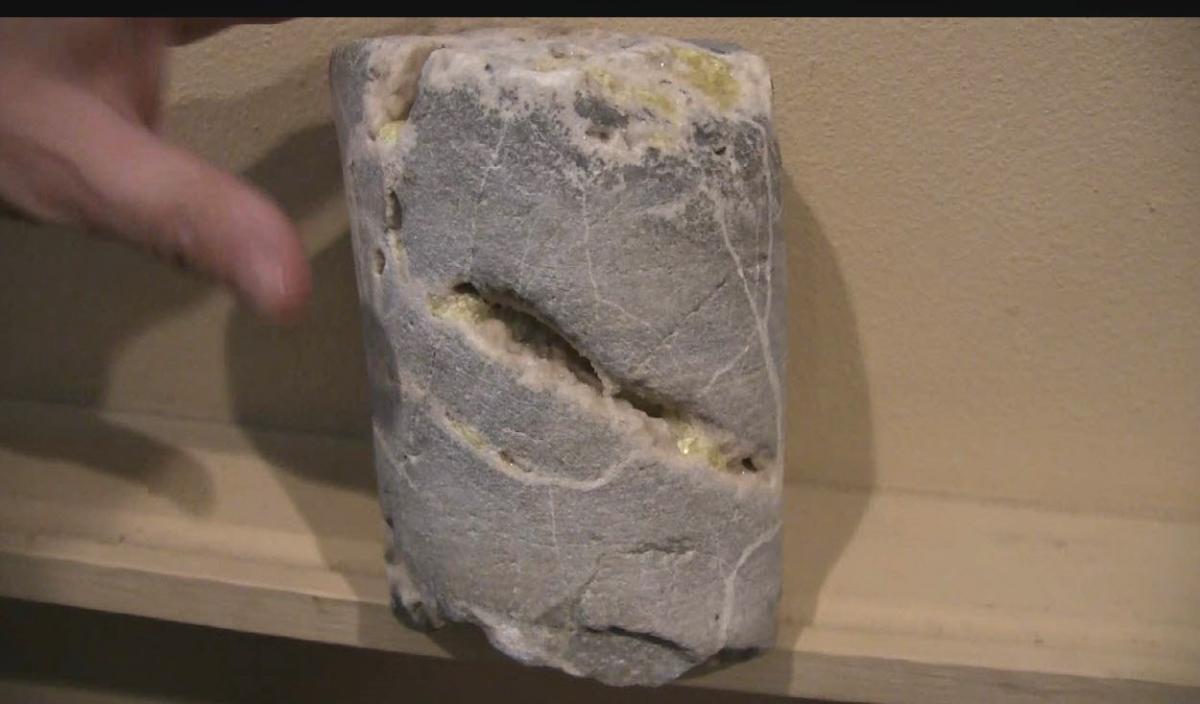
Samples of the gypsum and anhydrite cap rock were shown in the room. Prior to the discovery the Hill was known to have surface gas seeps with Patillo Higgins lit on fire. Geologists knew oil accumulated in anticlines, but did not associate oil with Texas hills and salt domes. Many geologists before 1901 dismissed Patillo Higgins attempts to convince investors that Big Hill (Spindletop) had oil. Anthony Lucas believed Higgins but had to invent new drilling techniques (like the rotary bit) to be able to drill to 1101 feet.
Everybody on the field trip enjoyed a short drive to the site of the Spindletop blowout off the 1-10 highway. Oil wells with rocking pumpers still produce oil from this historical oil field, over 114 later.
The Gladys City Museum has a daily recreation of the Spindletop blowout. The group witnessed a 10 minute blowout recreation, where water shoots over a wooden rig 100 feet into the air.
HGS Night at the Museum Entertains AAPG attendees on April 8
By Linda and Charles Sternbach
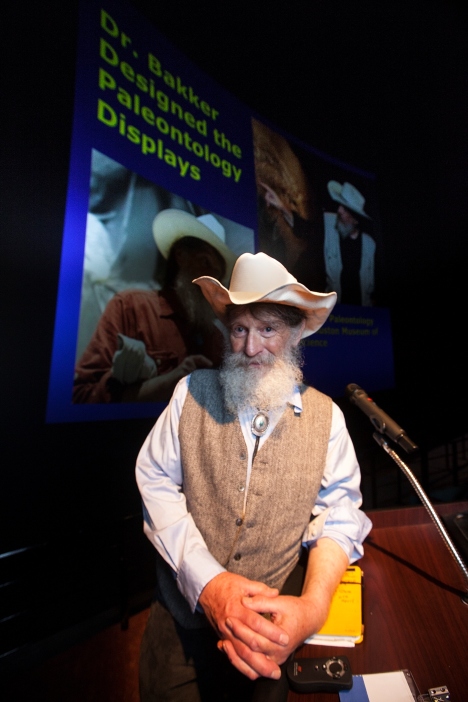
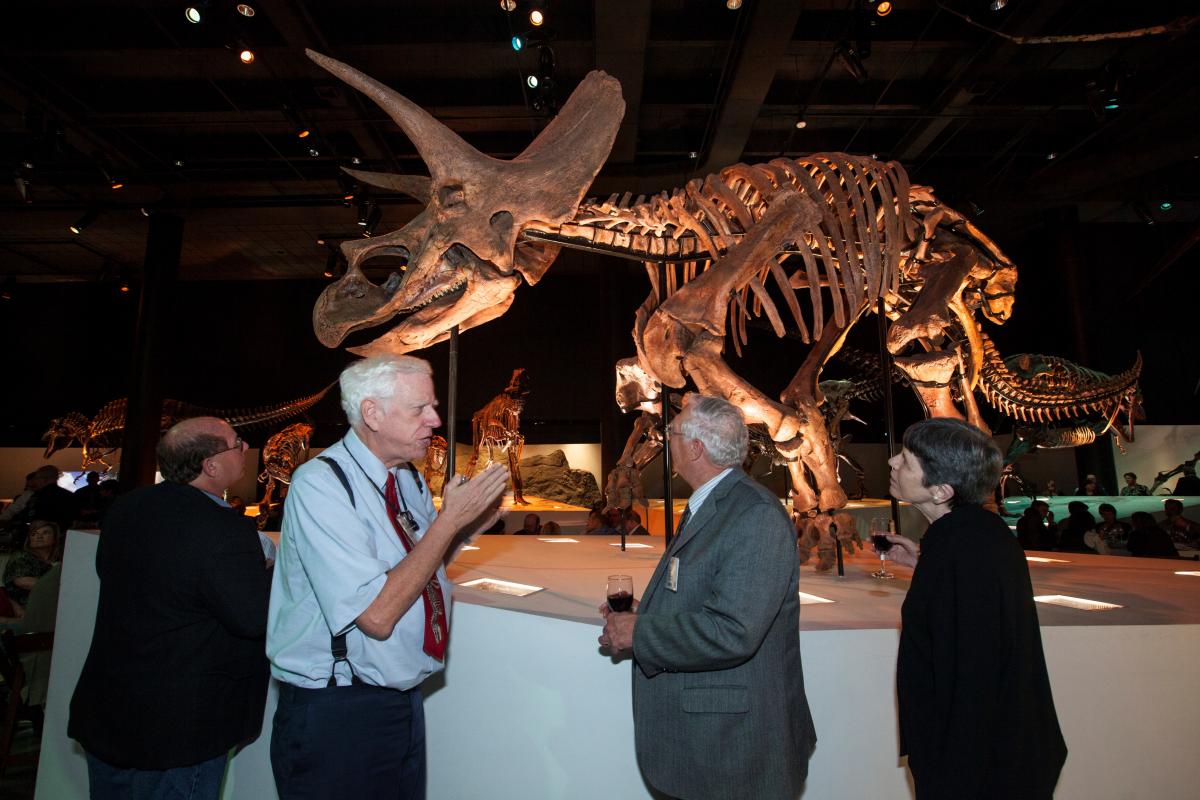
A sell-out crowd of 420 enthusiastic geoscientists and friends filled the Morian Hall of Paleontology at the Houston Museum of Natural Science on April 8. The HGS hosted a social evening during the AAPG annual convention on Tuesday night that featured a presentation by famous paleontologist Dr. Robert T. Bakker. Bakker is also Curator of Paleontology at the HMNS science museum. Attendees roamed among the large dinosaur displays of the Paula and Rusty Walter Mesozoic Gallery, enjoyed a buffet dinner and took photos. This was the first time that attendees to an AAPG annual convention, hosted in Houston, had the opportunity to see the dinosaur exhibits, which were created in 2012 under Dr. Bakkers’ supervision. About 200 of the 420 people who came to the Museum were from outside the Gulf Coast area, and many attendees saw the paleontology exhibit for the first time. The AAPG convention brought geoscientists to the social event from England, Mexico, Canada, and even New Zealand. Many participants expressed interest in joining both HGS and the HMNS.
 |  |
| Dr Robert T Bakker | Neal Immega |
Dr. Bakker summarized his presentation as a "geo-narrative of the Hall.” Bakker said,” I talked about how we arranged fossils to tell the story of progressive evolution. I researched our own Texas Red Beds (in Seymour, Texas) and found that fin-backed fossils surprise us. Their teeth and jaws got better and better bio-mechanically over time. Texas bones prove that all us Mammalia, the hairy-warm-blooded-milk-producing Class, came from very early land reptiles of the greater Dimetrodon clan".
Geoscientists can keep up with Dr. Bakker’s research at the Museum “Beyond Bones” blog at:
https://blog.hmns.org/category/paleontology/
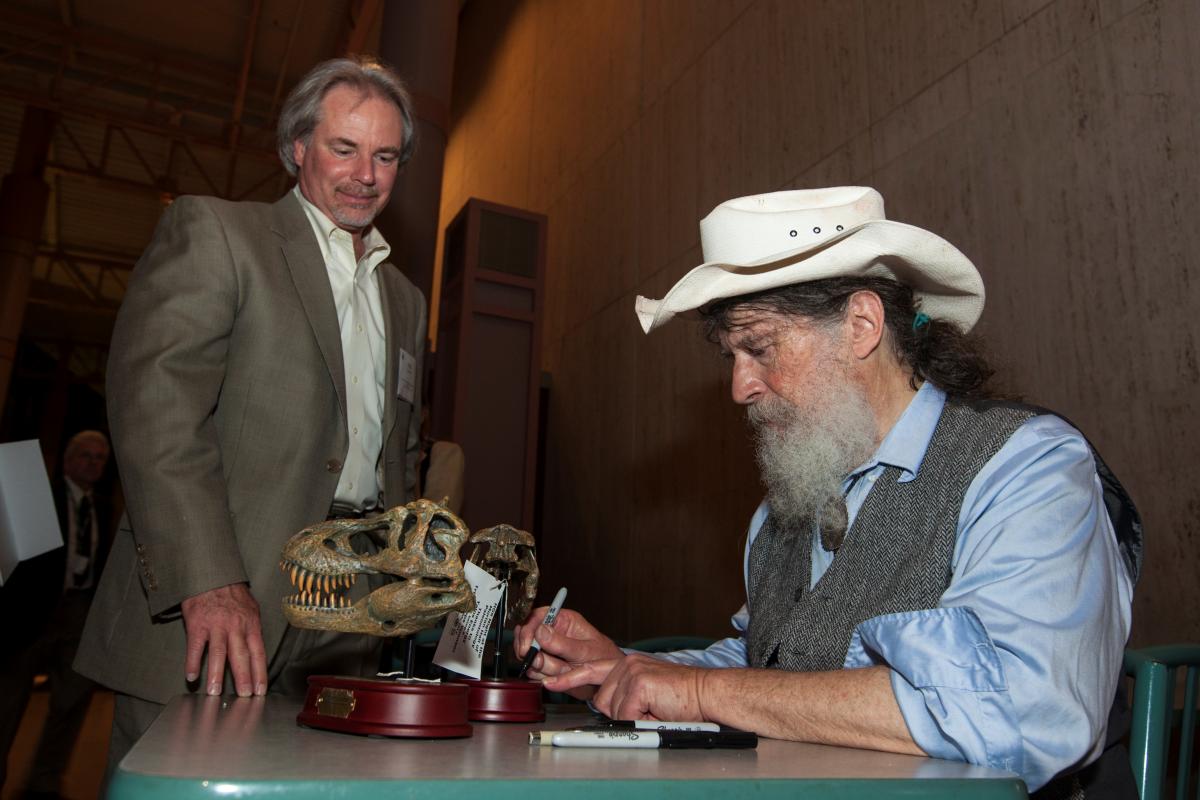
Many participants were able to meet Dr. Bakker and get his books personally autographed. These included his new “Golden Book of Dinosaurs” and his classic 1986 book, “Dinosaur Heresies,” both of which are also available as hardcopy from book sellers.
 |  |
| McArdle (center) |
The evening was made possible by a generous donation by Rusty and Paula Walter, and Walter Oil and Gas. Special thanks are due to Mike Jobe, past HGS board member and employee at Walter Oil and Gas for coordinating funding. In addition, generous support from Exxon Mobil, and Talos Energy, faciliated by John Adamick, further underwrote HGS graduate and undergraduate scholarships.
Many HGS volunteers helped make the HGS Night at the Museum a success. Thanks to Linda and Charles Sternbach who conceived of the event, booked Dr. Bakker,and reserved the date on the HMNS calendar a year and a half ahead of time, with the help of HGS past President Martin Cassidy. Sandy Rushworth and David Risch assembled a volunteer team to check in guests. Inda Immega recruited the Museum “docents”, trained volunteer experts on museum displays, to give presentations to guests. The docents included Neal Immega, Janet Combes, Michael Quintaro, Shirley Smalley, Gretchen Sparks, Richard Spaw and Diane Vitaska. Dawne Jordan coordinated the bus rental for the event. Lucy Plant and Alex Blaque helped with bus arrival and departure from the George R Brown Convention center on the night of April 8. Thanks to David Temple, associated curator of the Museum for arranging Dr. Bakker’s schedule and travel.
Heather McArdle is a Mahopac High School, New York geosciences teacher. Heather is the 2014 AAPG Teacher of the Year, following an award ceremony during theAAPG convention. She attended the HGS Night at the Museum and wrote the following letter: "The exhibits and docents were amazing. We found that our time at the AAPG Conference was exceptional. We've decided to return in the future. The HMNS museum is definitely on the list!”

Thanks to Sponsors Walter Oil and Gas, Exxon and Talos Energy



The Wise Report
Henry M. Wise, P.G
April 7, 2014
For those of you involved in Phase I Environmental Site Assessments, E 1527-13 is now in effect—and blessed by the U.S. EPA as AAI-compliant. EDR has a good analysis of what the changes are, and they are significant, including:
If the subject property or an adjoining property is identified in any of the standard environmental records sources, then performing an agency file review is not optional.
For more information go to: http://www.edrnet.com/blog/edr-insight-research/edr-insight/2014/03/impact-of-e-1527-13-agency-file-reviews?mkt_tok=3RkMMJWWfF9wsRoju6%2FJZKXonjHpfsX56uQrXa6xlMI%2F0ER3fOvrPUfGjI4FScRqI%2BSLDwEYGJlv6SgFTbHBMapjzrgNUxY%3D
Henry M. Wise, P.G.
The Wise Report
4/7/2014
|
| Over the years, the HGS has grown significantly. The Society’s annual budget now exceeds $1,000,000. The organization has expanded its office space and now has three full-time employees. From September through June, there may be as many as six monthly meetings organized by the Society. HGS continues to print a hard-copy magazine style monthly Bulletin. In addition, HGS now organizes at least two conferences each year, with international participation, as well as a number of short courses. The Society continues to be active in guaranteeing the future of our science and profession by supporting two funds which grant undergraduate and graduate scholarships. We also continue to support the Science and Engineering Fair of Houston, as well as Earth Science Week each year, and have approved a contribution toward an endowment that will guarantee long-term survival of the Science Fair. The Society also maintains several members’ social programs, such as the Tennis, Golf, and Skeet tournaments, as well as Guest Night.
|
| |
| The most notable, and perhaps last, global freezing event occurred approximately 650 to 635 million years ago during the Marinoan Epoch glaciation toward the end of the Cryogenian period (850 to 635 million years ago) in the Neoproterozoic era (approximately 1 billion to 542 million years ago). Some researchers, including a team led by Huiming Bao, Charles L. Jones professor in geology and geophysics at Louisiana State University, contend that this last period of extensive glaciation and the subsequent climate changes might have given rise to modern levels of atmospheric oxygen. This set the stage for the rise of animals and the later explosive diversification of life forms during the episode called the Cambrian explosion.
A continuing mystery is that the fossil record indicates that organisms and ecosystems do not appear to have undergone the significant change that would be expected by an extreme climate event or a potential mass extinction associated with the global glaciations. Even if life were to cling on in all the ecological refuges listed above, a whole-Earth glaciation should result in a biota with a noticeably different diversity and composition. This change in diversity and composition has not yet been observed in the fossil record — in fact, the organisms which should have been most susceptible to climatic variation emerge unscathed from the Snowball Earth.
|
|
|
There is more than AAPG for you to consider this month. The HGS Board has started considering awards and honors that will be presented this coming June. We have ideas but would like to hear from you. Are there members of the Society that you believe have contributed to the organization, the science, or the community? Send the Board a brief note letting us know who you believe should be recognized by the organization and why. At our January Board meeting, we decided to explore the idea of new awards so please don’t feel constrained by actions of prior boards. Remember, professional recognition is important. |
| |
| Samarium, Praseodymium, Terbium, Lutetium. These sound odd. Are these break-away republics from the old Soviet Union? Maybe some new wonder drugs for weigh loss or baldness? In fact, these are members of a group of chemicals known as rare earth elements.
|
The Wise Report
Henry M. Wise, P.G.
February 22, 2014
The Texas Commission on Environmental Quality (TCEQ) has released a revised draft of the guidance document titled “Conducting Ecological Risk Assessments at Remediation Sites in Texas” (RG-263) which is available at: http://www.tceq.state.tx.us/remediation/trrp/guidance.html.
This is the TCEQ’s main ecological risk assessment (ERA) guidance document and replaces the 2001 and 2006 versions, which are no longer available. Although a draft, it is usable in its current form while it continues to undergo revisions. The primary differences between this draft and earlier versions are:
The main purpose of this document is to promote the development of consistent and technically defensible ERAs to be submitted through TCEQ remediation programs operating under the TRRP Rule (30 TAC 350) and Risk Reduction Rule (30 TAC 335). This document provides a detailed description of how to conduct ERAs using TCEQ's three-tiered approach and includes technical advice and insight as to how the agency may evaluate ERAs. It also discusses the interactions of the ERA process with the role of the Natural Resource Trustees.
Questions about this document may be directed to the following TCEQ ERA program staff:
Larry Champagne (512-239-2158)
Vickie Reat (512-239-6873)
Jessica Mauricio (512-239-1765)
Or via e-mail at techsup@tceq.texas.gov.
Henry M. Wise, P.G.
The Wise Report
2/22/2014
The Wise Report
Henry M. Wise, P.G
February 16, 2014
The Texas Board of Professional Geoscientists (TBPG) General Issues Committee (Members are Krenz-Doe, Knobloch, Mathewson, and McNamee) met on February 14, 2014 in Austin. Matt Cowan, President of Texas Association of Professional Geoscientists, and myself, as President of American Institute of Professional Geologists – Texas Section, attended the meeting. The discussion I was most concerned about was the licensure of environmental professionals.
As it turns out, the agenda announcement wasn’t correct. There was not intent to discuss the licensure of environmental professionals but to discuss the boundaries of the Texas Commission on Environmental Quality’s (TCEQ’s) Corrective Action Project Manager (CAPM) license. Dr. Mathewson teaches a TEEX class for CAPMs. A recent class had eight CAPMs in it. Only one of them was a Texas PG, the rest were biologists and chemists. One of the biologists had been fined by the TBPG for practicing geology without a license. I don’t have all of the facts, but, in a nutshell, he drilled a well and collected a water sample for analysis for micro-organisms. I don’t know if he described the drill cuttings or not, but, as a biologist, he was within his realm of expertise for the water sample’s purpose.
Dr. Mathewson wanted to discuss with the TCEQ the parameters of what a CAPM can and can’t do. After some discussion and several motions, the matter died in Committee.
The TCEQ has recently issued the following documents:
Determining Representative Concentrations of Chemicals of Concern for Ecological Receptors, RG-366/TRRP-15eco (revised)
Determining representative concentrations, defining exposure areas, and evaluating potential hot spots.
http://www.tceq.texas.gov/publications/rg/rg-366_trrp_15eco.html
Status of Corrective Action at Petroleum-contaminated Sites, SFR-113/13 (new publication)
A report on the Petroleum Storage Tank State-Lead Program including the status of sites and recommendations on fees, programs, and activities to eventually conclude the program.
http://www.tceq.texas.gov/assets/public/comm_exec/pubs/sfr/113-13.pdf
TCEQ Annual Financial Report, Fiscal Year Ending August 31, 2013, SFR-045/13 (new publication)
A legislatively mandated report submitted annually to the Governor's Office, the Comptroller's Office, the Legislative Budget Board and the State Auditor's Office.
http://www.tceq.texas.gov/assets/public/comm_exec/pubs/sfr/045-13.pdf
TCEQ Area and Regional Offices: Map, List of Managers, Addresses, and Phone Numbers, GI-002 (revised)
Listing of Small Business and Environmental Assistance staff in TCEQ's regional offices.
http://www.tceq.texas.gov/publications/gi/gi-002.html
TCEQ Operating Budget for Fiscal Year 2014, SFR-030/13 (new publication)
Details the agency's operating budget for fiscal year 2014.
http://www.tceq.texas.gov/assets/public/comm_exec/pubs/sfr/030-13.pdf
Henry M. Wise, P.G.
The Wise Report
2/16/2014
The Wise Report
Henry M. Wise, P.G
February 8, 2014
The Texas Board of Professional Geoscientists (TBPG) will hold several committee meetings on February 14, 2014 in Austin. The one I found may be of general interest is the General Issues Committee (Members are Krenz-Doe, Knobloch, Mathewson, and McNamee). They will be discussing, among other things, the licensure of environmental professionals. The meeting is open to the public, if you wish to attend, or you can send the members of the committee your thoughts on the subject. The complete agenda can be found at: http://tbpg.state.tx.us/wp-content/uploads/2014/02/GIAgenda-02-14-2014.pdf.
Henry M. Wise, P.G.
The Wise Report
2/8/2014
The Wise Report
Henry M. Wise, P.G.
February 2, 2014
The Texas Commission on Environmental Quality (TCEQ) Sunset Legislation, House Bill (HB) 2694, Article 2, passed by the 82nd Legislature, 2011, and signed by the governor, transferred from the TCEQ to the Railroad Commission of Texas (RRC) duties relating to the protection of groundwater resources from oil and gas associated activities. Specifically, HB 2694, Article 2, amended the Texas Natural Resources Code to revise §91.011, add §§91.0115, 91.020, and 91.1015, and amended the Texas Water Code, §27.033. On September 1, 2011, the law transferred from the TCEQ to the RRC those duties pertaining to the responsibility of preparing groundwater protection advisory/recommendation letters. Since the transfer, the RRC has been responsible for providing surface casing and/or groundwater protection recommendations for oil and gas activities under the jurisdiction of the RRC.
The TCEQ's Surface Casing Program and staff transferred to the RRC on September 1, 2011. The RRC's Surface Casing Program was renamed the Groundwater Advisory Unit, and is now located in the William B. Travis Building, 1701 North Congress, Austin.
The RRC has adopted amendments to their regulations to reflect the changes in law made under HB 2694, Article 2. The rules in Chapter 339 authorized the executive director to provide groundwater protection letters to the RRC for use in various activities and applications before the RRC and to collect a fee for the expedited processing of a request for a groundwater protection recommendation. Because the executive director no longer provides the groundwater protection letters to the RRC, the commission's rules in Chapter 339 are no longer necessary. The RRC adopted amendments to their regulations on May 24, 2013. These regulations are effective January 1, 2014. Therefore, the commission proposes the repeal of §§339.1 - 339.3 in their entirety. For more information go to: http://www.sos.state.tx.us/texreg/sos/Proposed%20Rules/30.ENVIRONMENTAL%....
Henry M. Wise, P.G.
The Wise Report
2/2/2014
|
| 1. The rocks tell the story. Back in graduate school we were handed rocks and asked to tell their story — where they formed and how they changed through time. In the field, we learned about four dimensional relationships. Over my career, geology has become much more quantitative and computing capacity has grown. This has led to a growing reliance on numerical modeling and, unfortunately, a decrease in observations. One must remember that models are simplifications of nature. They have a purpose. Models check for consistency of an interpretation. Models provide a means to test what is possible. But only the rocks have recorded the history of a basin and they must be read to constrain our models. 2. Review the data and the foundation for an interpretation. Over the course of one’s career we are very often presented with a completed study and our time is limited so we focus on the executive summary, abstract, or key conclusions. I can’t suggest strongly enough that one needs to “trust but verify.” I have seen many cases where limited data have been stretched or twisted beyond reasonable limits. Some of the questions that I ask are: 1) are the data significant and statistically meaningful; 2) are there sufficient data for the area or stratigraphic interval of interest; and 3) are the data internally consistent? Furthermore, I have found that not all work has relied on appropriate foundation. Recently, while reviewing some manuscripts, I read an increasing number of papers simply stating that the interpretation guidelines differ because these samples came from country “X” or the work was down in country “Y.” Sorry, but chemical and physical principles are not country dependent. 3. Geology requires integration and context. Very often data are viewed out of context and their significance may be lost or overstated. As an example, many years ago as a new professional, I was reviewing data on Cretaceous anoxic events. I came across a large volume of data and many papers published on samples from Gubbio, Italy. This led me to the conclusion that the organic-rich black shales were extensive and volumetrically important. I then had an opportunity to visit the localities discussed; although the shale laterally extensive, it was no more than 1.5 meters thick. Much less important than I had thought. Context was clearly required. Integration also remains a key. Geology is multifaceted and a meaningful interpretation requires that multiple datasets and types be brought together. For example, as a geochemist I work with geochemical data, but to complete my interpretation and extend the interpretation beyond the sampling point, I often pull in stratigraphical information, paleoclimate data, and paleogeographical interpretations. 4. There are usually multiple valid interpretations. As a consequence of the number of unknowns in our work, multiple interpretations often exist. One is generally more probable than the others and one may be our preferred option. We need, however, to examine the alternatives and gain an understanding as to the probability of each. We then need to determine what additional work could be done to limit the number of options and focus in on the most likely case. 5. Communication is an important key. No matter how good an idea is it has no value unless it is effectively communicated. Remember that all communication is at least two ways. Ideas must be received. Tailor communications to your audience. A technical presentation and a management presentation are typically very different. One focuses on the details of the science, the data, and the why. The other focuses on the bottom line, the conclusions and the implications. As technical people, we are proud of all the details, but at times they may cloud the story. Be ready to provide the details and the necessary supporting information, but hold back until asked. 6. Good mentors and role models are important. Formal mentors are important. It is a relationship that you can depend on. A mentoring relationship, however, need not be formal and you may not even know that such a relationship exists. Search out people that you admire because of their technical knowledge or understanding of the business. Ask them to serve as a guide to your development. Over time your primary mentor may change as your needs and responsibilities change. You are never too experienced to have a mentor or a coach. Take every opportunity to learn something new. Ask why they see things the way they do. Remember that the relationship is two-way. Most professionals want to share their experiences and leave a professional legacy. 7. Learn to listen, not just hear. This is one that I am still working on. Realize that everyone was invited to the meeting for a reason and they have something to offer. Make sure that you understand not just the words but also the intentions. Ask for clarification if needed. As our industry becomes more global it is important to realize how cultural differences may influence a discussion. Sometimes “yes” doesn’t mean “yes” but rather “I hear you and will consider it”.When in doubt confirm what you think you heard. 8. Document your thought processes, not just the end product. In a world dominated by PowerPoint decks and bullet point summary slides, we very often lose the foundation for an interpretation. Why and how a conclusion is drawn is as important as the conclusion itself. Concepts evolve through time as a result of new data and analytical approaches or by integration of new technologies opening new opportunities where one didn’t exist. By documenting the reasoning for an interpretation, its technical robustness can be assessed through time and adjustments can be made. Remember- it wasn’t that long ago that fine-grained rocks were considered sources or seals and not reservoirs. Our understanding can change dramatically over time. 9. Things very often take longer than expected. All too often we underestimate the time a job takes. Generally this is a result of underestimating the complexity of the project, the dependency on the work of others, or problems that result from attempting to multi-task. It is always better to complete the job ahead of schedule than late. Learn to build a cushion when estimating time to completion. 10. The technical foundation evolves and one must adapt. A study of the history of geology has shown that there have been major changes in our overall understanding. Consider views on the age of the earth, the movement of plates, and evolution. New concepts develop and need to be considered. Think about the roles that seismic stratigraphy, sequence stratigraphy, and seismic geomorphology now play in our interpretations. Very often these develop as a result of new tools and higher quality data. One needs to incorporate new tools and concepts as they become available and their validity confirmed. This does require a scan of the literature to learn what’s new. I hope that these thoughts prove useful. Finally, I want to remind you that the HGS Applied Geoscience Conference — Integrated Approaches of Unconventional Reservoir Assessment and Optimization (Mudrocks) will be held this month on February 17-18, 2014. As has been the case in the past, Frank Walles and his team have put together an excellent technical program. If you are currently or planning to work in unconventional reservoirs, I strongly recommend that you attend. Until next time… |
| |
| The Energy-Water Nexus webpage of Sandia National Laboratories states: “These two critical resources are inextricably and reciprocally linked; the production of energy requires large volumes of water while the treatment and distribution of water is equally dependent upon readily available, low-cost energy. The nation’s ability to continue providing both clean, affordable energy and water is being seriously challenged by a number of emerging issues.”
The Search for Fresh Water and Conflicts
|
HGS Night at the Paleontology Museum April 8- includes Scholarship donations. By Linda and Charles Sternbach
HGS is hosting a fantastic “Night at the Paleontology Museum” on Tuesday Night, April 8, at 6:30pm at the Houston Museum of Natural Science . This is the featured local society social event of the 2014 AAPG Annual Convention in Houston at the George R Brown convention center. Your ticket buys you a delicious buffet dinner, drinks and amazement, as you sit right next to the huge dinosaur, reptile and fossil displays inside the Hall of Paleontology. Dr Robert T Bakker, famous paleontology, dinosaur and reptile expert, and HMNS Museum curator, will give a entertaining presentation at 8pm in the IMAX theatre. Dr. Bakker and HMNS curator David Temple will have just returned from a recent excavation fossil dig in North Texas with news about the latest discoveries of Permian reptiles and amphibians.
 The HGS encourages AAPG convention registrants to bring spouses and guests to this social event. Registration is online at the AAPG 2014 convention website at http://www.aapg.org/houston2014/. AAPG registrations can buy one or more tickets as they register for the convention. As you register for the AAPG conventon, look for the tab called Guest/Social Events. Adult tickets are $65, students are $35. Buses will take ticketed registrants to and from the HMNS Museum at 5555 Hermann Park Drive, Houston 77030. There will also be free garage parking for private cars. If you already registered for the AAPG convention, but need to add or buy tickets to the HGS Night at the Museum, call the AAPG Registration Center c/o The Pulse Network 781-821-6732. Get tickets now, as the event may be sold out by the time the convention opens April 5. The attendance limit is 400 people.
Bob Bakker
Walter Oil and Gas generously donated $25,000 to this HGS Night at the Museum event . Rusty Walter, CEO of Walter Oil and Gas, is an important financial backer of the HMNS Morian Hall of Paleontology. The Walter family donated funds to create the Paula and Rusty Walter Jurassic Mesozoic Gallery (opened in 2012), which includes action- posed dinosaurs including a Triceratops, three T- Rexs, a Diplodocus, and a Stegosaurus. Charles Sternbach, event chair, would like to thank CEO Rusty Walter and geologist Mike Jobe for their support of this joint HGS- AAPG convention event.

Additional fund raising is also taking place as a result of the Night at the Museum Event. The HGS Scholarship Fund is looking for several corporate sponsors for this event to increase the funding of the graduate and undergraduate scholarship program. John Adamick, Vice President of TGS-Nopec, and former HGS Board member, and chair of the HGS Foundation Scholarship fund (with Carl Norman) volunteered to round up corporate sponsors . John Adamick is seeking T-Rex sponsors at the $5,000 level, Triceratops sponsors at the $2500 level, and Trilobite sponsors at $1000 level.
Sponsorship includes some free tickets and logo recognition. Interested companies can use the form included in the Bulletin, or online at the HGS webpage event site calendar on April 8. Sandra Babcock, the HGS office manager can take checks and credit cards and assist in sponsorship organization. Contact John Adamick at 713-860-2114 john.adamick@tgs.com, and Sandra @hgs.org.

triceratops in the Walter Mesozoic Gallery

|
| First, resolve to volunteer some time at a school and talk about geology in general, the energy business, and geology as a career. Each January and May, I volunteer at the elementary school where my older daughter teaches. I spend a day talking with the 5th grade students. It is amazing what a few slides, rock samples, and experiments can do! The kids seem to really enjoy learning about how rocks and oil are formed, why earthquakes happen, how mountains form, and where the dinosaurs went. At my daughter’s request, this year I will be focusing on the formation of rocks. If you take me up on this challenge be prepared to answer all types of questions, because they always want to know more. Some of their questions are not technical but focus on how long I went to school and how much money I make. I answer the first question and defer the on the second. Second, resolve to learn something new this year. We are never too old to expand our knowledge. There are many ways we can approach learning, but this is not a passive process. HGS provides excellent opportunities through meetings, conferences, and short courses for its members. For example, consider attending next month’s Mudrocks Conference (February 17-18) “Integrated approaches to unconventional reservoir assessment and optimization” or the Annual AAPG Convention and Exhibition in April, which the HGS will be hosting. At the convention, HGS will be sponsoring two short courses – “Shale Reservoir Evaluation” and “Introduction to Geohazards Assessment.” Consider attending those as well. For more in depth learning, I recommend that you consider presenting or publishing a paper. The preparation of a paper provides an opportunity not only for delving into a subject’s background but allows one to move the science forward. A paper also presents an opportunity for peerreview, which helps to clarify and strengthen one’s thoughts. Personally, this year I plan on presenting at least one new paper on the anatomy of a source rock. The New Year also represents the mid-point of my term in office and I would like to provide a brief look-back. There are a number of highlights to focus on. HGS in association with ARMA (American Rock Mechanics Association) held our first Geomechanics Conference – “Interdisciplinary Micro to Macroscale Geomechanics.” The four oral sessions and three poster sessions were heard by over 250 attendees at the conference. HGS held eighteen dinner and luncheon meetings since September, with several filling the meeting room, including Art Berman’s talk “Let’s be Honest about Shale Gas” and the R.E. Sheriff Lecture by Cindy Yeilding’s “What a Difference a Few Decades Makes: Exploration History of the US Gulf of Mexico Deepwater” where registration hit 200. Through mid-November there were more than 900 seats filled at these meetings. The HGS Golf Tournament was held at the Kingwood Country Club. The Outreach Committee held a series of successful events associated with Earth Science Week. The Board and office team also spent considerable time and energy dealing with membership rolls and what may be done to further increase the membership, including the conversion of student members to active members. As part of this process, inactive members were contacted and about 900 returned to active membership mid-way through November. Policies and procedures were also examined and we continue to make great strides toward a more business-like approach. Part of this has been a streamlining of the committee structure. The Society’s finances have been better than expected. Our expenses have been less than projected and our revenue has been greater than expected. There was also considerable discussion on procedures for elections. The Board has approved some minor changes and these will be brought forward to the membership with the regular election ballot. The major change proposed dealing with the number of candidates for each office was not approved and will not be brought forward to the membership for a vote. And now a look forward. There is still half a year left and things are lining up to ensure that it will also be quite a busy six months. In addition to the Society’s regular monthly meetings, the second half of the year will include the Mudrocks Conference, the Annual AAPG Convention, and the Grand Canyon Field trip. “A Night at the Museum” will be held as part of the AAPG Convention and will be used as a fund-raising event for the two HGS scholarship funds. Please consider attending and/or sponsorship of the event. HGS will be publishing the “Field Guide to Late Cretaceous Geology of the Big Bend Region” by Roger W. Cooper and Dee Ann Cooper. Also on the calendar are several of the social activities that the membership has come to look forward to including Guest Night, the Tennis Tournament, and the Skeet Shoot. Look for more on these items and others as the year progresses. Until next month… |
|
|
|
The Wise Report
Henry M. Wise, P.G.
December 21, 2013
The Texas Board of Professional Geoscientists (TBPG) adopts an amendment to 22 TAC §850.62, concerning the general powers and duties of the TBPG, without changes to the proposed text as published in the August 30, 2013, issue of the Texas Register (38 TexReg 5676). The amendment implements the requirements provided in Senate Bill (SB) 138. Language was added to the rule to require the TBPG to work with other state agencies that use the services of a person licensed by the Board to educate their employees on how complaints are filed with and resolved by the TBPG.
The TBPG or Board also adopts amendments to 22 TAC §§851.10, 851.101, and 851.157 concerning the licensure and regulation of Professional Geoscientists. TBPG adopts §851.10 and §851.101 without changes to the proposed text as published in the August 30, 2013, issue of the Texas Register (38 TexReg 5677). TBPG adopts §851.157 with changes to the proposed text as published in the August 30, 2013, issue of the Texas Register (38 TexReg 5677). The amendments to §851.10 and §851.101 are administrative in nature and move a sentence regarding TBPG's jurisdiction over a license, registration or certification from §851.10 to §851.101. The amendments to §851.157 provide that a state agency that becomes aware of a potential violation of the Act or a rule adopted by the Board may fulfill the requirements of the Act by filing a formal complaint with the Board or providing the information relating to the potential violation in writing to TBPG staff; it also provides that a state agency will notify TBPG regarding the confidentiality of information it provides. Adopted amendments to §851.157 also provide that information provided by a state agency that is privileged or confidential remains privileged or confidential following receipt by the Board. Adopted amendments to §851.157 also specify that complaints must be submitted to the authorized deputy to the Secretary-Treasurer and that the Board shall accept a complaint regardless of whether the complaint is notarized.
For more information go to: http://www.sos.state.tx.us/texreg/sos/Adopted%20Rules/22.EXAMINING%20BOARDS.html#120
Henry M. Wise, P.G.
The Wise Report
12/21/2013
The Wise Report
Henry M. Wise, P.G.
December 8, 2013
A new Texas Risk Reduction Program (TRRP) Guidance Document titled “Determining Representative Concentrations of Chemicals of Concern for Ecological Receptors” (RG-366/TRRP-15eco) is now available at the following link: http://www.tceq.texas.gov/publications/rg/rg-366_trrp_15eco.html.
This document presents guidance for determining representative concentrations of chemicals of concern for use in ecological risk assessments conducted under TRRP. Particular topic areas include:
• ensuring that data used in ecological risk assessments (ERAs) are representative and appropriate for each exposure medium
• defining exposure areas for ecological exposure pathways
• evaluating potential hot spots for ecological exposure pathways
• identifying outliers and describing composite sampling related to ecological exposure pathways
This document is primarily intended for persons conducting a Tier 2 screening level ecological risk assessment (SLERA), as specified in the TRRP rule at 30 TAC 350.77(c). Persons performing a SLERA should use this document in addition to the TCEQ’s 2001 Ecological Risk Assessment Guidance (ERAG) as a resource. The ERAG is currently unavailable on the Texas Commission on Environmental Quality’s (TCEQ’s) website but can be obtained by contacting Larry Champagne (larry.champagne@tceq.texas.gov) or Vickie Reat (vickie.reat@tceq.texas.gov). TCEQ is working to have a revised draft version of the ERAG available for downloading.
--------------------------------------------------------------------------------------------------------------------------------------------
Texas State Agencies are required to conduct a four-year rule review to see whether the reasons for initially adopting their rules continue to exist. The Texas Board of Professional Geoscientists (TBPG) is conducting its four-year rule review, now through 2014. The TBPG wants to make every effort possible to elicit stakeholder participation in this process. Now is the time for you to make recommendations for readoption, amendments, or repeal of the authorizing statutes. For more information go to: https://tbpg.state.tx.us/rulereview.html.
Henry M. Wise, P.G.
The Wise Report
12/8/2013
The Wise Report
Henry M. Wise, P.G.
December 1, 2013
The Railroad Commission of Texas (RRC) proposes amendments to coal mining regulation §§12.3, 12.100, and 12.116, relating to Definitions; Responsibilities; Identification of Interests and Compliance Information; the repeal of §12.155, relating to Identification of Interests; amendments to §12.156, relating to Identification of Interests and Compliance Information; new §12.206, relating to Mining in Previously Mined Areas; amendments to §§12.215, 12.216, 12.221, 12.225, 12.226, 12.228, 12.232, and 12.233, relating to Review of Permit Applications; Criteria for Permit Approval or Denial; Conditions of Permits: Environment, Public Health, and Safety; Commission Review of Outstanding Permits; Permit Revisions; Permit Renewals: Completed Applications; Transfer, Assignment or Sale of Permit Rights: Obtaining Approval; Requirements for New Permits for Persons Succeeding to Rights Granted under a Permit; the repeal of §12.234, relating to Responsibilities: General; and new §12.234 and §12.235, relating to Challenge of Ownership or Control, Information on Ownership and Control, and Violations, and Applicant/Violator System Procedures; and Responsibilities: General; and amendments to §§12.239, 12.395, and 12.560, relating to Application Approval and Notice; Revegetation: Standards for Success; and Revegetation: Standards for Success; new §12.676, relating to Alternative Enforcement; and amendments to §12.677, relating to Cessation Orders.
The RRC proposes these amendments, repeals, and new sections to update provisions of the Texas Coal Mining Regulatory and Abandoned Mine Land Programs as set forth in the notification letter dated September 30, 2009, from the federal Office of Surface Mining Reclamation and Enforcement (OSM), requiring that, pursuant to 30 CFR §732.17(d), Texas revise its regulations to be as effective as the federal regulations. OSM approved the proposed amendments in the February 19, 2013, issue of the Federal Register (78 Fed. Reg. 11579). For more information go to: http://www.sos.state.tx.us/texreg/sos/Proposed%20Rules/16.ECONOMIC%20REG...
Henry M. Wise, P.G.
The Wise Report
12/1/2013
|
| The Gas and Its Physical Properties
Helium, named for the Greek god Helios, was first detected in 1868 by the French astronomer Jules Janssen and the British physicist Norman Lockyer in the spectra from a solar eclipse. In 1895, helium was formally discovered on Earth by the Swedish chemists, Per Teodor Cleve and Nils Abraham Langlet. The Swedes observed the gas emanating from the uranium ore cleveite. Geological Origin
|
|
| Let’s consider the facts as we know them. Over the past several years, largely as a result of the growth of unconventional resources, shale oil and shale gas, there has been an increase in the number of practicing geologists in the greater Houston area. Many, if not most , arrived directly from the university. The interests and needs of this new generation of professionals are different from those that have been engaged in the past. Their approaches to learning and networking are different from prior generations. They see the Internet as a key connector. Many of today’s practicing geologists are approaching the end of their professional careers and after three decades of drawing maps and making cross-sections, they are readying themselves for the golf course, tennis courts, and fly fishing. These retiring geologists will be disengaging from their profession and their needs will be shifting. Corporations, although generally supportive of professional organizations, have pulled back and are less supportive of their staff being actively engaged and are much more selective in what they fund. Majors and independents are running leaner and demanding more from their staff, with many workers feeling that they are on call 24/7. This has reduced everyone’s free time and families and friends come before professional organizations such as the HGS. Committees and positions on the boards that run these professional organizations tend to be stagnant, with the same individuals engaged. Changes, when present, are often a result of the shifting of responsibilities among the same group of people rather than the infusion of new blood. Renewals of memberships to professional organizations, such as the HGS and AAPG, have suffered over the past several years. We received notification recently that as a result of a lack of AAPG membership renewals there could be a reduction in the number of seats allocated to Houston in the House of Delegates. Drops in the HGS membership rolls have been even greater than those seen at AAPG. It is unclear, however, how much of this decrease was a result of complications associated with the transition to a new website that was fraught with bugs. Even taking this website complication into consideration there appears to be a significant reduction by choice in the membership roster. A review of the facts has resulted in some definitive actions and the initiation of a series of discussions and debates. Problems with the website have been resolved and credit card payment can be made online and the “member only” portions of the website are really limited to dues paying members. HGS has sent a letter to all individuals that dropped off of our membership rolls during the past 18 months, when the website renewal became problematic. As of the preparation of this note, two weeks after the letter was mailed, about 10% those contacted have rejoined. The Houston membership of the House of Delegates has just started to contact those individuals that have not renewed their AAPG membership to ask them to renew and remind them of the benefits of membership. The HGS Board, as well as a number of past-Presidents, is in an ongoing debate as to how elections should be held. The question is largely one as to whether the process continues as is or is it modified to reflect what is the new reality of reduced membership and a smaller pool of individuals that are interested in serving on the Board. By the time this reaches your desk at least part of this debate will be over. Either a change in the bylaws will be finally approved by the Board and will be presented to the membership for ratification or a new discussion will begin as to how we can increase the numbers of those members interested in serving on the Board and as committee members and chairs. In either case, whether the bylaws are modified or not, the active discussion now needs to focus on not simply having our members return to an active status but also on how we engage the next generation of geoscientists to become not simply dues paying members but active members, participating in committees and being willing serve on the Board. If we simply rely on those that have been engaged to continue to run for office we will be heading over a cliff. We need to learn what the new professionals need and want from our organization so that they will take the first step and join. We as an organization then need to work the next step, increased involvement. Relevancy is of increasing importance when we ask individuals to give more than their annual dues as they are asked to contribute their most precious of all commodities – their time. As we work toward the next generation, we also need to ensure that the needs of the more senior members are still provided for. It clearly is a balance that we must all work towards. Although this will be an area for the Board to discuss for the next several months I ask that you become engaged. Let the Board know your thoughts. Talk to those that you work with, especially those that are not members of HGS, and ask what they would like to see HGS do that would convince them to join. Let us know, so we can begin the adjustments needed. If I have learned anything over the past several months, it is that changing this organization is similar to that of changing the direction of a supertanker. The process is slow and needs to be deliberate. On a very different note, we are now into the holiday season. I would like to take this opportunity for myself, my wife Terry, and the members of the HGS Board to wish you a happy and healthy holiday and New Year. May all your wishes and prayers be answered. Until next time… |
The Wise Report
Henry M. Wise, P.G
November 9, 2013
The Texas Commission on Environmental Quality (TCEQ) proposes amendments to §§39 (public notice), 55 (requests for reconsideration and contested case hearings, public comment), 101 (general air quality rules), 106 (permits by rule), 116 (control of air pollution by permits for new construction or modification), and 122 (federal operating permits program). If adopted, the TCEQ will submit these changes to the United States Environmental Protection Agency (EPA) as revisions to the state implementation plan (SIP). These changes are the result of the recent U.S. Supreme Court ruling that greenhouse gases (GHGs) fit within the Federal Clean Air Act (FCAA or Act) definition of air pollutant. This ruling gave EPA the authority to regulate GHGs from new motor vehicles and engines if EPA made a finding under FCAA, §202(a) that six key GHGs taken in combination endanger both public health and welfare, and that combined emissions of GHGs from new motor vehicles and engines contribute to pollution that endangers public health and welfare. EPA issued its "Endangerment Finding" for GHGs on December 15, 2009, (Endangerment and Cause or Contribute Findings for Greenhouse Gases Under Section 202(a) of the Clean Air Act, Final Rule, as published in the December 15, 2009, issue of the Federal Register (74 FR 66496)). Based on the Endangerment Finding, EPA subsequently adopted new emissions standards for motor vehicles (the "Tailpipe Rule" as published in the May 7, 2010, issue of the Federal Register (75 FR 25324)). The rule established standards for light-duty motor vehicles to improve fuel economy thereby reducing emissions of GHGs. The standards were effective January 2, 2011. EPA also reconsidered its interpretation of the timing of applicability of Prevention of Significant Deterioration (PSD) under the FCAA (the "Timing Rule" as published in the April 2, 2010, issue of the Federal Register (75 FR 17004)). EPA's interpretation of the FCAA is that PSD requirements for stationary sources of GHGs take effect when the first national rule subjects GHGs to regulation under the Act. EPA determined that once GHGs were actually being controlled under any part of the Act they were subject to regulation under the PSD program. Specifically, EPA took the position that beginning on January 2, 2011, GHG control requirements would be required under the PSD and Title V permitting programs because national standards for GHGs under the Tailpipe Rule were effective on January 2, 2011.
House Bill (HB) 788, 83rd Legislature, 2013, added new Texas Health and Safety Code (THSC), §382.05102. The new section grants TCEQ authority to authorize emissions of GHGs consistent with THSC, §382.051, to the extent required under federal law. THSC, §382.05102 directs the commission to adopt implementing rules, including a procedure to transition GHG PSD applications currently under EPA review to the TCEQ. Upon adoption, the rules must be submitted to EPA for review and approval into the Texas SIP. THSC, §382.05102 excludes permitting processes for GHGs from the contested case hearing procedures in THSC, Chapter 382; Texas Water Code, Chapter 5; and Texas Government Code, Chapter 2001. THSC, §382.05102 also requires that the commission repeal the rules adopted under this authority and submit a SIP revision to EPA, if (at a future date) GHG emissions are no longer required to be authorized under federal law.
The proposed rulemaking in Chapters 39 and 55 would make two changes to the commission's rules that are distinguishable from current public participation rules and the Texas SIP. First, PSD GHG permit applications would not be subject to an opportunity to request a contested case hearing or reconsideration of the executive director's decision. Second, based on EPA interpretation of its rules, there may be no requirement for the commission to prepare an air quality analysis for proposed emissions of GHG, and, if so, there will be no such analysis available for public comment.
HB 788 specifically excludes PSD GHG permit applications from the requirements relating to a contested case hearing. Requests for reconsideration were added by HB 801 (76th Legislature, 1999) as an alternative to the opportunity to request a contested case hearing. However, this remedy is not independent of the right to request a contested case hearing. Absent a right to request a contested case hearing, there is no independent right to request reconsideration of the executive director's decision. The TCEQ interprets HB 788 to require that all other HB 801 requirements, apply to GHG permit applications.
For more information go to:
----------------------------------------------------------------------------------------------------------------------------------------------------------
The TCEQ adopts an amendment to §336.1115 with changes to the proposed text as published in the July 5, 2013, issue of the Texas Register (38 TexReg 4300), as corrected in the July 19, 2013, issue of the Texas Register (38 TexReg 4653). This rule is the result of a petition for rulemaking by Barrett & Associates, PLLC on behalf of Uranium Energy Corp. (UEC), Radioactive Materials License Number R06064, to amend the decommissioning standards applicable to radioactive source material (i.e., uranium mining) sites and by-product disposal sites so that the standards will conform to federal requirements.
As requested in the petition, the commission adopts the amendment to §336.1115(e) to remove paragraph (3) and amend paragraph (4) to reflect the Radium Benchmark Dose approach as the clean-up standard (in addition to the radium standard) for release of outdoor areas for unrestricted use. In considering the petition, agency staff reviewed the current language in §336.1115(e) and determined that inclusion of a specific soil standard for the concentration of uranium in soil is not consistent with the federal requirements of the United States Nuclear Regulatory Commission (NRC). The federal regulations set a standard for the concentration of radium in soil and require a risk-based dose assessment, but do not establish a specific concentration limit for uranium. A decommissioning standard for the concentration of uranium in soil is not necessary because the required risk-based radium benchmark dose assessment approach accounts for the radioactivity of the radionuclides in soil, including uranium.
The licensing program for uranium mining has transferred several times from the TCEQ and the Texas Department of State Health Services (DSHS). When the program was previously at TCEQ, the TCEQ proposed rules and invited comments on including a standard for the concentration of uranium in soils in a 1997 rulemaking (Rule Log Number 1997-154-336-WS). In response to comments from the NRC, however, the TCEQ did not adopt a standard for uranium (See May 27, 1997, issue of the Texas Register (22 TexReg 4593)). After the program was transferred to DSHS in 1997, it appears the standard for uranium was picked up as a requirement in DSHS rules without any specific explanation. The current TCEQ rule language was carried back over from the rules of DSHS when the licensing program was transferred by Senate Bill 1604 in 2007 (Rule Project Number 2007-060-336-PR). The dose-based approach was added in the rule in response to a comment from the NRC, but the limit for the uranium concentration was not removed from the rule. Accordingly, the commission now adopts the rule to remove the uranium concentration requirement to be consistent with the applicable federal requirements.
For more information go to: http://www.sos.state.tx.us/texreg/sos/Adopted%20Rules/30.ENVIRONMENTAL%2...
Henry M. Wise, P.G.
The Wise Report
11/9//2013
The Wise Report
Henry M. Wise, P.G.
November 4, 2013
The Louisiana Board Of Professional Geoscientists (LBOPG) has released their website and grandfathering application. In an effort to maximize efficiency, the LBOPG is creating a web based Application form for data entry directly into their database. Because of the possibility of delays to the completion of this form, the LBOPH is accepting a preliminary Grandfathering Application Form to ensure grandfathering status for applicants. Under the above provision, any geoscientists who want to gain the grandfathered status must use the Grandfathering Application Form. This form is downloadable from the lbopg.org website.
The first step of the application procedure is to complete and mail a Grandfathering Application Form and a check in the amount of $200, to the Board at the address: LBOPG, P.O. Box 14209, Baton Rouge, Louisiana 70898. In addition, a digital copy of the completed form should be emailed to apply@lbopg.org. All of this must be recieved by January 1, 2014.
The submittal of this grandfathering application and the fee is only a part of the application procedure. In order to complete the application process, the applicant must fill out the regular application forms electronically through this website. The web based application forms will be made available when the work is complete.
Upon the receipt of both the grandfathering application and the regular application forms, along with all other required documents, the LBOPG will review the completed applications and make decisions regarding the issuance of the applicant's P.G. License.
Henry M. Wise, P.G.
The Wise Report
November 4, 2013
|
| 1. The HGS is suffering from the same demographic issues as the oil and gas industry, and the key “boomer” generation is beginning to retire in large numbers. There is a significant gap in the number of mid-career individuals, representing the general lack of hiring during the downturn of the 90s. Historically, geologists become most active in professional societies during their mid-career. The newer employees are spending much of their time learning the needed skills and, in some cases, growing their families. Until next month… |
|
The ability to tie a sand, soil, sediment, or alluvial sample to a specific location is one of the most powerful tools of the science of forensic geology. Forensic geology is the study of the Earth and earth materials to solve crimes and aid in legal cases. The earliest and still the primary textbook on forensic geology was written by Rutgers University professors Ray Murray and John Tedrow in 1975. However, Professor Murray, and several others, credit Sir Arthur Conan Doyle as the originator of forensic geology. Doyle was the creator of the fictional detective Sherlock Holmes in a series of crime stories that ran from 1886 to 1903. The character Sherlock Holmes claimed to be able to identify where an individual had been by various methods, including observing soil or clay on a person’s clothing or shoe and matching the material to a specific location based on his detailed study of the exposed geology of London. Forensic geology has been used by the Federal Bureau of Investigation and other law enforcement agencies for many years to develop evidence and to match sediment samples to unique locations. Perhaps the most remarkable story of tying a sediment sample to a specific place occurred during World War II.  During World War II, the Japanese looked for a way to strike at the United States mainland. The Doolittle Raid in April 1942, launched in response to the the attack on Pearl Harbor in December 1941, embarassed the military, and left the Japanese feeling vunerable. The American B-25 bombers struck Kobe, Nagoya, Yokosuka, Yokohama, and Tokyo. But after the loss of four critical aircraft carriers at the Battle of Midway in June 1942, the Japanese no longer had any realistic chance of attacking the 48 contiguous states. This desire for relatiliation set in motion a Japanese balloon bomb project. During World War II, the Japanese looked for a way to strike at the United States mainland. The Doolittle Raid in April 1942, launched in response to the the attack on Pearl Harbor in December 1941, embarassed the military, and left the Japanese feeling vunerable. The American B-25 bombers struck Kobe, Nagoya, Yokosuka, Yokohama, and Tokyo. But after the loss of four critical aircraft carriers at the Battle of Midway in June 1942, the Japanese no longer had any realistic chance of attacking the 48 contiguous states. This desire for relatiliation set in motion a Japanese balloon bomb project.The balloon bombs were designed to carry high explosives and incendenary devices to the United States homeland. The incendary devices were intented to ignite woodland conflagrations. There was a widespread belief in Japan that the United States was a heavily-forested country where wildfires could cause major disruptions of the war effort and general panic. These were an early weapon of terror. The unmanned balloons were constructed of a laminated paper envelope 30 feet in diameter that held approximately 19,000 cubic feet of hydrogen when fully inflated with a lifting power at sea level of one thousand pounds. The plan called for releasing armed balloons which would rise into the strong winds that flow during the winter months from west to east across the Pacific. A Japanese meteorologist had discovered these powerful winds at altitudes above 30,000 feet. This current of air later became known as the jet stream. The planners calculated that the armed balloons could cross the five thousand miles of ocean in three days. The Japanese had created the first intercontinental missile with twenty times the range of the German V-1 rocket. The technlogical problems for the developers were acute. In sunlight, the balloons would rise as the hydrogen heated and in darkness the balloons would descend. The repeated rising and falling would jeopardize the integrity of the laminated paper envelope and reduce the likelihood of a successful delivery. To address these issues, the planners added a release valve, altimeter, and ballast weights. The ballast would be automatically jetisoned as needed to maintain the optimum flight altitude. The ballast consisted of sand in a series of paper sacks mounted on the perimeter of the gondola. The sand for the ballast was collected from a beach nearby the site of the balloon launches. Between late 1944 and early 1945, the Japanese launched more that 9,300 balloon bombs at the United States. At least 300 of these weapons reached our shores. The bombs landed in Alaska, Washington, Oregon, California, Arizona, Idaho, Montana, Utah, Wyoming, Colorado, Kansas, Nebraska, the Dakotas, Michigan, Iowa, and Texas. Canada and Mexico also recorded arrivals of the balloon bombs.  Two balloon bombs landed in rural Texas. According the the Texas Almanac, one touched down in Desdemona in Eastland County and one in Woodson in Throckmorton County. Local reports indicate that, on March 23, 1945, local school children saw the Desdemona balloon drifting to the earth where they examined the device and collected pieces of it for souvenirs. Government officials arrived in Desdemona the next day to recover the wreckage and request the return of the “souvenirs.” Two balloon bombs landed in rural Texas. According the the Texas Almanac, one touched down in Desdemona in Eastland County and one in Woodson in Throckmorton County. Local reports indicate that, on March 23, 1945, local school children saw the Desdemona balloon drifting to the earth where they examined the device and collected pieces of it for souvenirs. Government officials arrived in Desdemona the next day to recover the wreckage and request the return of the “souvenirs.”Sixty miles to the northwest the following morning, Ivan Miller, a cowboy on the Barney Davis ranch eight miles north of Woodson, was checking cattle when he came upon a collapsed balloon. The balloon had a large rising sun painted on its top. The postmaster was notified soon after the discovery, and in the early afternoon, government officials arrived to take charge of the situation. As in Desdemona, school children showed great interest in discovery and took souvenirs. And again, government officials requested that the pieces be returned. At the time, it was inconceivable to American strategists that the balloons had travelled thousands miles across the ocean from Japan. Military leaders thought the balloons might be coming from West Coast beaches launched by landing parties. Other theories suggested the balloons were launched from submarines, nearby Pacific islands, German prisoner-of-war camps, or the Japanese-American internment centers. The United States government considered the balloon bombs a serious threat. They believed news of the waves of Japanese bombs drifting over the United States would spread a great concern through the American public. A strict news blackout was enforced to prevent the spread of reports of the airborne bombs and to keep the Japanese from knowing the effectiveness of the attacks. Many officials feared that the next step would be a balloon-borne bacteriological attack as Japan had previously lauched in Manchuria. Japanese propaganda broadcast s reported that great fires were sweeping though the forests of the western states and that the American population was in panic. Thousands of casualities were reported in the Japanese press. By early 1945, the American general public was becoming aware of the unusual threat. Despite the threat, the only American casualities of the balloon bombs were five Sunday school children and a minister’s wife. The minister and his wife had taken the children on a fishing trip in May 1945 to Bly in southern Oregon, east of the Cascade Mountains. They discovered a downed device which detonated and killed the six instantly. These were the only Americans killed in the continental United States by enemy action in World War II. Some of the bags of the sand ballast had been recovered from balloon crash sites. The sand samples were provided to the Military Geology Unit of the United States Geological Survey to see if they could determine the location where the sand was collected and thereby the launching site. The Military Geology Unit was established in June 1942, six months after the Pearl Harbor attack. The Unit studied battlefield locations to assist the armed forces with identifying building materials, drinking water sources, and suitable sites for the construction of airfields and other facilities. The Unit also studied beaches to develop recommended landing areas. The Unit had a wartime roster of 88 geologists, 11 soil scientists, 6 bibliographers, 5 engineers, 3 editors, 1 forester, and 43 administrative staff members. The Military Geology Unit was dissolved in 1975. To the geologists, it was immediately clear that the balloon ballast sand was not from North America or even from mid-Pacific islands. Using the tools available at the time, including polarizing microscopes and X-ray diffraction, the geoscientists delved into the genesis of the samples. Even with the small sample size, micropaleontogists were able to identify more than one hundred species of diatoms. Diatoms, a major group of algae, are abundant and widespread throughout the world’s oceans. There are three hundred genera of diatoms and twenty-five thousand species, and in one liter of sea water, there are one hundred thousand to one million diatoms. The ballast sand was obviously beach sand from a beach where there was a mixture of recent and fossil diatoms. Studying papers published by Japanese geologists before the war, the researchers were able to eliminate large parts of the county. Published papers described similar diatoms around Sendai, on the Honshu coast, northeast of Tokyo. Interestingly there was no trace of coral in the samples. Coral does not grow in cold water. In Japan, the northern extent of coral growth is near the latitude of Tokyo. The absence of coral fragments eliminated the beaches in the southern half of the country. Minerologists found an unusual suite of minerals that included no granitic material. This eliminated all beaches north of the thirty-fifth parallel where streams carry eroded granitic material from the inland areas. The mineralogists identified hypersthene, augite, hornblende, garnet, high-titanium magnetite, and hightemperature quartz. The high percentage of hypersthene and the unusal assemblage of minerals narrowed the potential locations of the balloon preparation area to just a few beaches. A foramiferia specialist on loan from Texaco looked at the sand samples for single-celled microscopic creatures with calcareous shells. The forams identified in the samples occurred on the east coast of Japan north of Tokyo and nowhere else on the planet. Finally, the Military Geology Unit narrowed the search for the balloon bombs origin to two locations roughly two hundred miles apart. Because of the absence of coral, geologists favored the more northerly location along the great beach of Shiogama, close to Sendai. Based on the geologist’s findings, aerial photo-reconnaissance was conducted identifying the balloon manufacturing facilties. American B-29 bombers destroyed two of the three hydrogen plants effectively ending the balloon bomb program. The war was largely over by the time the geologists’ work led the Army Air Corps to the balloon bomb hydrogen plants in 1945. So, while their efforts may not have had any direct affect on the ultimate outcome of the conflict, the geoscience community stepped up aid in the United States in a time of national threat. |
Earth Science Week
Art, Essay, and Multimedia Contest
Sponsored by Houston Museum of Natural Science, Houston Geological society, and Consumer Energy Alliance
Art
1st place- Sophia Villarreal, 4th grade, St. MIchaels Catholic School, Teacher: Susie West
2nd place- Dina Owers, 5th grade, Harvard Elementary School, Teacher: Barbara Smith
3rd place- Alexis Morgan, 5th grade, Harvard Elementary School, Teacher: Barbara Smith
Essay:
1st place- James Morgan, 7th grade, St Rose of Lima Catholic School, Teacher: Naomi Fitzgerald
2nd place- Abby Lobue, 6th grade, New Caney 6th grade Campus, Teacher: Jennifer Reyes
3rd place- Jordan Obenhaus, 6th grade, New Caney 6th grade campus, Teacher: Jennifer Reyes
Multimedia:
1st place-Elizabeth Hannsz, 6th grade, New Caney 6th grade campus, Teacher: Jennifer Reyes
2nd place- Deslynn Vasquez, 6 th grade, New Caney 6th grade campus, Teacher: Jennifer Reyes
3rd place- Adrian Royas, 6th grade, New Caney 6th grade campus, Teacher: Jennifer Reyes
The Wise Report
Henry M. Wise, P.G.
October 5, 2013
The Texas Commission on Environmental Quality (TCEQ) has proposed rulemaking to implement House Bill 788, 83rd Legislature, 2013, Regular Session, which requires that the TCEQ adopt rules for the authorization of emissions of greenhouse gases (GHGs) to the extent required under federal law. The proposed rules establish GHGs thresholds for Title V and Prevention of Significant Deterioration (PSD) permits, clarify how emissions of GHGs are implemented in the emissions inventory and emissions fee rules, specify the PSD GHG permit applications are not subject to requirements regarding a contested case hearing, and specify that GHGs do not have a reportable quantity (RQ) for emissions event reporting purposes. The proposed rules also address a rulemaking petition from 3M Company to establish an RQ of 5,000 pounds for C6 Fluoroketone, a fire protection fluid. For more information go to: http://www.tceq.texas.gov/rules/pendprop.html#13040.
---------------------------------------------------------------------------------------------------------------------
The TCEQ proposes rulemaking that would remove existing language in Section 336.1115(e) to eliminate the uranium soil concentration standard. This rulemaking is a follow-up to a petition filed by the Uranium Energy Corp. For more information, go to: http://www.tceq.texas.gov/assets/public/legal/rules/rule_lib/adoptions/13029336_aex.pdf and/or http://www.tceq.texas.gov/assets/public/legal/rules/rule_lib/adoptions/13029336_ado.pdf.
---------------------------------------------------------------------------------------------------------------------
The National Ground Water Association Newszine for October 4, 2013 reports that the US Government shutdown has forced 94% of the EPA staff to be furloughed, the result of suspended cleanup at 505 Superfund sites in 47 states. For more information go to: http://newsmanager.commpartners.com/ngwanz/issues/2013-10-04/index.html#1
---------------------------------------------------------------------------------------------------------------------
The TCEQ has a new publication, “Joint Groundwater Monitoring and Contamination Report 2012, SFR-056/12”. This publication lists all groundwater contamination cases documented during the previous calendar year for which enforcement action was incomplete at ht e time of the preceding report. The report can be found at http://www.tceq.texas.gov/publications/sfr/056.
---------------------------------------------------------------------------------------------------------------------
The TCEQ has revised their publication “Risk-Based NAPL Management, RG-366/TRRP-32”. This document explains the risk-based management approach for non-aqueous phase liquid under the Texas Risk Reduction Program (TRRP) rule and presents a five-step process to address the rule requirements. The publication can be found at: http://www.tceq.texas.gov/publications/rg/rg-366_trrp_32.html
---------------------------------------------------------------------------------------------------------------------
The TCEQ has a new publication “How to Sample Your Well Water and Understand the Results, GI-433”. This publication would be helpful for clients who want to know if flooding, etc. has affected their well. It can be found at: http://www.tceq.texas.gov/publications/gi/gi-433.html.
Henry M. Wise, P.G.
The Wise Report
10/5/2013
|
| I, too, have been looking at things a bit differently. I realize that more of my career and professional life is behind me, rather than in front of me. The questions that I have been asking myself focus on whether or not I will leave behind a legacy. Legacies are important as they remind the world that you have been here, and hopefully, contributed in some way. Part of one’s legacy is represented by their children and grandchildren. Knowing that my two daughters, Rebecca and Michelle, are generous with their volunteer time and contribute to their communities, I rest comfortably that one portion of my legacy is secure. Now I must examine my professional legacy. Where do I believe that I stand? More than three decades have passed since I first drove through the gates at Texaco. Many of my thoughts and ideas have been documented in a history of publications and presentations at a number of conferences in the US and around the globe. These contributions to the science represent part of my legacy. However, the most important part of my legacy will be the people that I have touched through teaching and mentoring. I have been engaged in formal and informal mentoring for about half of my career. With each one of my mentees, we sit and review data and discuss possible interpretations. We speculate on career opportunities and consider how one develops professionally. During these times together, we often talk about a data set or problem that is similar to one that I dealt with in the past. Today’s young professionals are well-trained academically, but lack experience and with the “crew change” approaching, it is the lack of “stories” that will represent the challenge. The lack of experience will lead us down a path where Abraham Maslow’s quote “if you only have a hammer, you tend to see every problem as a nail” becomes a reality. Yes, part of my role as a mentor is to show the new arrivals how to do a number of things and provide them with the “facts” as we know them today, but more importantly it is to fill their toolbox with stories. The telling of stories is an important part of mentoring and knowledge transfer. It also turns out to be fun and reinvigorating by bringing us back to where we made our geologic marks. So why the above discussion? First, a little bit of sentimentality and more importantly a request that you become engaged in mentoring. For those of you with a “few” years of experience, seek out a mentor or a groups of mentors. They will provide you with knowledge well beyond your years, on the technical side of your career, and how to develop and enhance your career. For those of you that have had a long and successful career seek out someone to mentor. Your legacy can only grow. One last note, registration is open for the first HGS Geomechanics Conference. The conference will be held at the Westin Memorial City, November 4-5. Consider making this conference part of your continuing education program. Until next month… |
|
 In the 18th century, most Europeans and Americans embraced a world view in which nature was seen as complete, full, and perfect, as created by God. Within this model, each species was as the creator made it and no species ever became extinct because such an event would destroy the perfection of nature. Toward the end of the 18th century, the concept that no species had ever become extinct was increasingly challenged by evidence from the fossil record. The developing science of geology was going through a revolution as the field transitioned from a series of casual observations of the natural world by gentlemen scholars to a rigorous science. In 1788, the Scottish physician James Hutton, published Theory of the Earth; or an Investigation of the Laws observable in the Composition, Dissolution, and Restoration of Land upon the Globe in theTransactions of the Royal Society of Edinburgh.His work laid out the fundamental principles of geology postulating that erosion and sedimentation were part of continuing processes that had occurred throughout Earth’s history. Wit h t hes e precept s , he recognized the great age of the Earth. In the 18th century, most Europeans and Americans embraced a world view in which nature was seen as complete, full, and perfect, as created by God. Within this model, each species was as the creator made it and no species ever became extinct because such an event would destroy the perfection of nature. Toward the end of the 18th century, the concept that no species had ever become extinct was increasingly challenged by evidence from the fossil record. The developing science of geology was going through a revolution as the field transitioned from a series of casual observations of the natural world by gentlemen scholars to a rigorous science. In 1788, the Scottish physician James Hutton, published Theory of the Earth; or an Investigation of the Laws observable in the Composition, Dissolution, and Restoration of Land upon the Globe in theTransactions of the Royal Society of Edinburgh.His work laid out the fundamental principles of geology postulating that erosion and sedimentation were part of continuing processes that had occurred throughout Earth’s history. Wit h t hes e precept s , he recognized the great age of the Earth.In the decades preceding the American Revolution and for a period afterwards, tales of strange and gigantic creatures roaming the interior of the barely charted North American continent made their way east. Thomas Jefferson avidly collected such accounts as they were important for his view of science. Jefferson believed that these accounts described undiscovered species of mastodons, mammoths, wooly rhinoceros, and huge predators. While Jefferson did not believe in extinction and may not have grasped the concept of deep time, he maintained a life-long interest in fossils. Because his interest in fossils was widely known, many people sent him unusual specimens of large bones found on the American frontier. Over many years he amassed a large collection of “mammoth” remains, which he displayed in the entrance hall of Monticello, his great house in Virginia.  So it was, that in 1799 that Colonel John Stuart sent Jefferson some bones of a huge mammal "of the clawed kind" that had been found in a cave in the Blue Mountains in Greenbrier County (presentday West Virginia) by workmen mining sodium nitrate. The bones consisted of parts of an upper and lower arm with extremely large claws at the end of each finger. Jefferson was fascinated. By careful comparisons with the anatomical accounts of other animals, he ultimately concluded the bones were those of a huge unknown cat of some sort "three times as large as the lion." So it was, that in 1799 that Colonel John Stuart sent Jefferson some bones of a huge mammal "of the clawed kind" that had been found in a cave in the Blue Mountains in Greenbrier County (presentday West Virginia) by workmen mining sodium nitrate. The bones consisted of parts of an upper and lower arm with extremely large claws at the end of each finger. Jefferson was fascinated. By careful comparisons with the anatomical accounts of other animals, he ultimately concluded the bones were those of a huge unknown cat of some sort "three times as large as the lion."Jefferson described this creature in his writings and named it Megalonyxor "great claw." In March 1797, he presented his findings to the American Philosophical Society under the title, A Memoir of the Discovery of Certain Bones of an Unknown Quadruped, of the Clawed Kind, in the Western Part of Virginia. Many consider this to be the first scientific report on paleontology published in the United States. Before Thomas Jefferson was elected as the third president of the United States of America, he was elected president of the American Philosophical Society in 1797. He held the office of president of the American Philosophical Society until 1814, throughout serving two terms as the President of the United States.  The American Philosophical Society was founded in Philadelphia by Benjamin Franklin in 1743. The American Philosophical Society website (www.amphilsoc.org) states that the society is "an eminent scholarly organization of international reputation, the American Philosophical Society promotes useful knowledge in the sciences and humanities through excellence in scholarly research, professional meetings, publications, library resources, and community outreach. This country’s first learned society, the APS has played an important role in American cultural and intellectual life for over 250 years." The American Philosophical Society was founded in Philadelphia by Benjamin Franklin in 1743. The American Philosophical Society website (www.amphilsoc.org) states that the society is "an eminent scholarly organization of international reputation, the American Philosophical Society promotes useful knowledge in the sciences and humanities through excellence in scholarly research, professional meetings, publications, library resources, and community outreach. This country’s first learned society, the APS has played an important role in American cultural and intellectual life for over 250 years."Benjamin Franklin advocated for the society by noting that, “the first drudgery of settling new colonies is now pretty well over and there are many in every province in circumstances that set them at ease, and afford leisure to cultivate the finer arts, and improve the common stock of knowledge.” Early members included doctors, lawyers, clergymen, and merchants interested in science, and also many learned artisans and tradesmen like Franklin. Many founders of the republic were members: George Washington, John Adams, Alexander Hamilton, Thomas Paine, Benjamin Rush, James Madison, and John Marshall; as were many distinguished foreigners: Lafayette, von Steuben, and Kosciusko. Later, illustrious names were continually added to the membership roster, reflecting the society’s scope. These included Charles Darwin, Robert Frost, Louis Pasteur, Elizabeth Cabot Agassiz, John James Audubon, Linus Pauling, Margaret Mead, Maria Mitchell, and Thomas Edison. Thomas Jefferson’s contributions to the study of geology in the United States were considerable. He established the United States Geodetic Survey and the United States Coast Survey (1807), the forerunner of the United States Geological Survey. Jefferson proposed the adoption of the Public Land Survey System that was the foundation of the township and range system familiar to most geologists. He sponsored the Corps of Discovery Expedition in 1804 to the newly-acquired Louisiana Purchase under the command of Captain Meriwether Lewis and Second Lieutenant William Clark and encouraged the search for minerals and fossils. Jefferson very much hoped that the expedition would find evidence of both living mastodons and Megalonyxin the vast unexplored American West beyond the Appalachian Mountains: "In the present interior of our continent there is surely space and range enough for elephants and lions, if in that climate they could subsist; and for the mammoth and megalonyxes who may subsist there. Our entire ignorance of the immense country to the West and North-West, and of its contents, does not authorise us so say what is does not contain."
In his 1951 article Thomas Jefferson and the Geological Sciences, Joel Martin Halpern, Professor of Anthropology at the University of Massachusetts, noted that Jefferson, like scientific thinkers before him, puzzled with the problem of marine fossils in the rocks on mountain tops. While studying fossil shells found in the Andes of South America at an elevation of 15,000 feet above sea level, Jefferson was not willing to accept this as evidence of a global, biblical deluge. Jefferson observed that there was no source of water that could cover the Earth to a depth of 15,000 feet. He calculated that converting the entire atmosphere to liquid would cover the globe only to a depth of 35 feet. Jefferson concluded that the deluge hypothesis was "unsatisfactory and we must be content to acknowledge that this great phenomenon is yet unsolved." |
The Wise Report
September 28, 2013
Henry M. Wise, P.G.
From the National Ground Water Association Newszine, September 27, 2013 (http://newsmanager.commpartners.com/ngwanz/issues/2013-09-27/index.html) The U.S. Environmental Protection Agency’s Superfund office is planning to ease its policy that favors cleanup of contaminated groundwater to meet strict drinking water standards, with a top official saying the agency plans to consult states on whether or how to weigh groundwater uses when setting cleanup objectives, according to Inside Washington Publishers.
Jim Woolford, director of EPA's Office of Superfund Remediation and Technology Innovation, said September 17 during a panel discussion before the Environmental Council of the States at its annual meeting in Arlington, Virginia, that the agency is considering a "flexible approach to setting remedial objectives" for contaminated groundwater. However, he called it a "very sensitive issue" that will require discussions with states.
Included will be discussions with states about how they determine groundwater uses, which may help the agency "set a different cleanup objective, different cleanup level than just what is in the [drinking water maximum contaminant level (MCL)]," he said. Discussions are expected to begin with states next month.
If the agency adopts the changes, it could soften a policy that has long driven costly cleanups that can require pump-and-treat remediation systems that liable parties are often required to fund.
Where cleanups are particularly complicated, such as where the resource is contaminated with so-called dense non-aqueous phase liquids (DNAPLs)—chemicals like trichloroethene (TCE) or chemical mixtures that are heavier than, and only slightly soluble in, water—those pump-and-treat remedies can be permanent.
But in cases where no liable parties are viable and the Superfund trust fund has covered the cost of remediation, states are ultimately required to cover such long-term operation and maintenance costs after the trust fund has covered those costs for 10 years.
The agency's push aligns with some of the recommendations contained in a landmark National Academies of Science's 2012 report that is gaining increased attention among state regulators, EPA, and others.
The report, "Alternatives for Managing the Nation's Complex Contaminated Groundwater Sites," examined the future of groundwater remediation efforts and found that at complex groundwater sites, poorly accessible or recalcitrant contaminants have complicated or prevented site closure.
Facing dwindling budgets and federal funds, states raised the cost concern earlier this year when U.S. House of Representatives Republicans advanced legislation that sought to ease state requirements under federal hazardous waste law. For example, Daniel Miller, senior assistant attorney general for Colorado, told a May 17 hearing before the House Environment and Economy Subcommittee that rather than advancing legislation to allow judicial review of EPA cleanup decisions, lawmakers should instead address states' concerns that some remedies that the EPA favors, such as long-term groundwater pump-and-treat systems, shift cost burdens to states that must cover operation and maintenance costs.
In the Superfund program, Woolford said there are more than 1600 total sites, with 90% of them having groundwater issues. The EPA's Web site said DNAPLs are likely to be present at 60% of Superfund sites. In addition, regulators said the issues over groundwater cleanups affect a broad spectrum of sites—cleanups under brownfields and the Resource Conservation & Recovery Act (RCRA) programs as well as the Superfund program.
Henry M. Wise, P.G.
The Wise Report
September 28, 2013


 It is Now Time to Vote

 The Snowball Earth concept posits that, during these exceptional cold events, the atmosphere was prevented from warming because most of the incoming solar radiation was reflected back into space by the whiteness of ice and snow covering the oceans and land surface. A lack of heat-retaining clouds and atmospheric moisture, caused by water vapor freezing out of the atmosphere, further amplified this effect. This resulted in average equatorial temperatures of about minus 10 degrees Fahrenheit, roughly similar to presentday conditions in Antarctica. Without the moderating effect of open oceans, the Earth’s climate became much like that of Mars. However, due to some atmospheric sublimation (ice to vapor) and condensation, snow would continue to fall, glaciers would thicken and flow, and sedimentary deposits of glacial origin would be left behind as geological evidence of these severe conditions.
 Many geologists have grappled with these puzzling low-latitude glacial deposits. One of the earliest was the Australian geologist and Antarctic explorer Douglas Mawson (1882–1958). Sir Mawson, a Fellow of the Royal Society, on the first team to ascend Mount Erebus, Antarctica’s tallest peak, and on the first team to reach the magnetic South Pole, spent much of his career studying the Neoproterozoic stratigraphy of South Australia where he identified thick and extensive glacial sediments. Late in his career, he speculated about the possibility of global glaciations. However, his ideas of global glaciation were hampered by the mistaken assumption that the geographic positions of Australia, and all the other continents were fixed in their present positions. Not until the development of the plate tectonic theory could geologists see the whole picture of lowlatitude glacial deposits.
 The moniker “Snowball Earth” was coined by Joseph Kirschvink, a professor of geobiology at the California Institute of Technology, in a paper titled “Late Proterozoic low-latitude global glaciation: the Snowball Earth” published in a multidisciplinary study by the Cambridge University Press in 1992. The major contributions from this work were: (1) recognition that the presence of banded iron formations is consistent with a glacial episode where the atmosphere is depleted in oxygen and (2) introduction of a mechanism with which the Earth could escape from an ice-covered condition. This mechanism is the increasing accumulation of atmospheric carbon dioxide (CO2) from volcanic outgassing leading to an ultra-greenhouse effect.
 Paleomagnetic data indicate that during the Cryogenian period, encompassing the Sturtian and Marinoan glaciations, most of the continental landmasses were located in the Earth’s warmer equatorial regions. This suggests that the rate of silicate weathering was high, lowering atmospheric CO2 concentrations, slowing greenhouse heating, and cooling the global climate. The global cooling lowered the silicate weathering rate, ultimately stabilizing the climate system at a new colder state.
 Escape from Snowball Earth
 On the continents, the melting glaciers would release massive amounts of water and glacial sediment flowing to the oceans. The resulting sediments supplied to the ocean would be rich in mineral nutrients which, combined with the abundance of CO2, would trigger a cyanobacteria population explosion, causing a relatively rapid re-oxygenation of the atmosphere. Researchers suggest that this vastly different oxygen-rich world was the setting for the rise of the Ediacaran biota and the subsequent Cambrian explosion. This positive feedback loop of mechanisms would free the Earth from ice in an astonishingly short period of time, perhaps less than 1,000 years. However, replenishment of atmospheric oxygen and depletion of the CO2 levels by ocean absorption and biological uptake would take further millennia.
 The Geology of Rare Earth Elements
 A common feature of most carbonatite and alkaline intrusion-related deposits is that the surrounding rocks have been hydrothermally altered because of alkali metasomatism. This style of alteration is known as fenitization, so-named because it was first described at the Fen alkaline complex in southern Norway. Alkali-rich fluids are released into the country rock from the crystallizing magma, and reactions convert the host rock minerals to an assemblage of alkali-bearing minerals. Fenites can be classified as sodium or potassium rich. Sodium-rich fenites are characterized by the presence of alkaline feldspar with alkali amphibole or sodic pyroxene, and potassium-rich fenites contain potassium feldspar.
 Expensive Extraction
 Strategic Implications
 Average rainfall in parts of south Texas amounts to less than 20 inches per year. During many of the recent years, precipitation totals have fallen short of the annual average and the region is suffering through a persistent long-term drought. According to the United States Drought Monitor for the end of December 2013, more than 71 percent of Texas is in drought and large parts of south Texas are still in moderate or severe drought conditions despite recent rainfall. Under the rolling hills, scrub brush, and dusty ranch lands of south Texas lies the Eagle Ford Shale.

 The Evergreen Underground Water Conservation District, encompassing all of Atascosa, Frio, Wilson, and Karnes counties, includes 2,461,000 acres or 3,845 square miles. The District’s economy is heavily dependent upon agriculture and agriculture related business. Approximately 80 percent of the total groundwater pumpage in the District is used in agriculture. The District, which overlies areas of Eagle Ford Shale production has implemented groundwater use restrictions for fracturing activities since 2008. The restriction limits the pumpage of fresh groundwater and brackish groundwater based on the acreage that the owner holds.
 The program to study the deep sea gas hydrate deposits is led by the Japan Oil, Gas and Metals National Corporation (JOGMEC) and Japan’s National Institute of Advanced Industrial Science and Technology (AIST). The project is being conducted in collaboration with the United States Geological Survey (USGS) Gas Hydrates Project and researchers from the School of Civil and Environmental Engineering at Georgia Tech. This project is one component of an ongoing Japanese collaboration on methane hydrate research with the United States Department of Energy (DOE) and the Gulf of Mexico Gas Hydrate Joint Industry Project (JIP).
 Methane molecules can fit within both the small and large sites in the Structure I lattice, the most common type found in nature. Thus, “gas hydrate” and “methane hydrate” are often used interchangeably by researchers.
 Potential Development

 Because helium migrates and is trapped in the subsurface under conditions that also trap hydrocarbons, the greatest natural concentrations of helium on the planet are found in natural gas. Most unprocessed natural gas contains at least trace amounts of helium, yet very few natural gas fields contain commercially exploitable concentrations. Helium concentrations in natural gas vary over a wide range from a few parts per million to greater than 70,000 parts per million (7 percent). Natural gas must contain at least 0.3% helium to be considered as a potential helium resource.
 Helium Production and Storage
 The Future