The Value of a Second Look
In geoscience, value is not always found in discovering something new; often uncovered by seeing something familiar differently. This issue reflects that idea across multiple fronts, from revisiting mature assets to rethinking how we approach the subsurface.
Most geoscientists will work on a mature field at some point in their careers. With fewer large-scale discoveries and rising energy demand, the industry increasingly focuses on maximizing production from existing assets which account for nearly 70% of global oil production. In this context, re-exploration is no longer optional, it is routine: revisiting legacy data, applying new tools, and extracting overlooked value from known systems. Built on existing wells, infrastructure, and decades of data, these assets remain central to how exploration is done today.
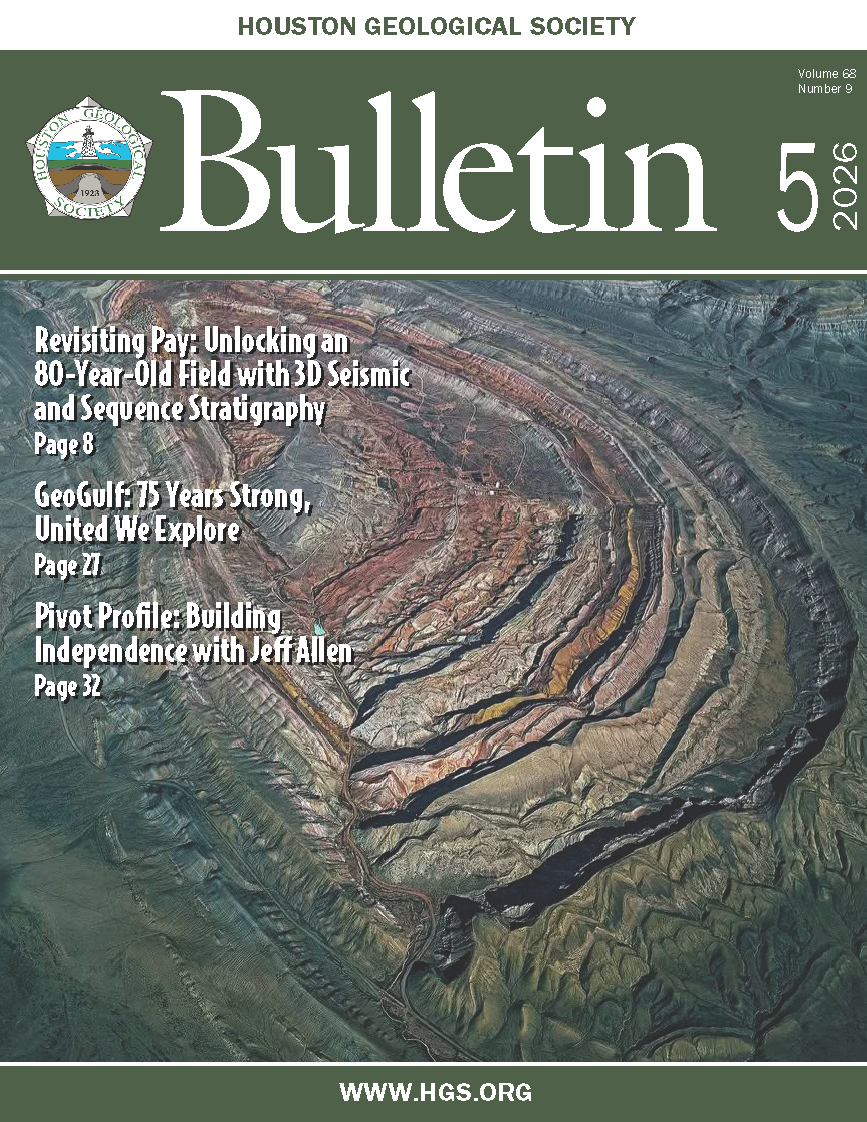
Our feature technical article shows this in practice through the re-evaluation of a long-neglected field in the Powder River Basin, where 3D seismic and sequence stratigraphy reveal how much still remains to be unlocked in an 80-year-old system when viewed with a modern lens.
That same mindset is evident among independents. In this issue’s Pivot Profile, Jeff Allen represents a younger generation that doesn’t wait for new frontiers, but instead creates opportunity by revisiting existing ones, combining technical discipline, timing, and a willingness to take risk.
We see it again in the next generation through the Imperial Barrel Award (IBA). Having advised teams over several years, I’ve seen students work across both frontier and mature basins, consistently challenging assumptions and producing interpretations that feel strikingly close to real exploration workflows. That same spirit of mentorship and industry connection also comes through in this issue’s We Are the HGS profile, where experienced professionals help shape the next generation of geoscientists.
Even in the field, this theme carries through. At GeoGulf 2026, participants revisited classic Gulf Coast systems, including salt dome fields in Louisiana: long-studied settings that continue to yield new insights when approached with modern perspectives.
Across experience levels, the message is consistent: progress is not driven only by new data, but by new ways of seeing it. The opportunity often lies in looking again, with better tools, sharper questions, and a willingness to rethink what we thought we knew.
In this Issue of the Bulletin
· Revisiting a Mature Field with Modern Tools
In this issue’s technical article, Sharma Dronamraju presents a case study from the Lower Cretaceous Newcastle Formation in Wyoming, demonstrating how integrated 3D seismic interpretation and sequence stratigraphy can redefine subsurface understanding and unlock overlooked potential in an 80-year-old field.
· GeoGulf: 75 Years Strong, United We Explore
In a recap by Linda
Sternbach, GeoGulf 2026 marked the 75th anniversary of Gulf Coast Association
of Geological Societies with strong attendance, key technical highlights
-including a major South Louisiana discovery-m and renewed momentum across the
Gulf Coast geoscience community. Charles Sternbach outlines plans for GeoGulf
2027 in Houston, centered on the theme “United We Explore.”
Building Independence with Jeff Allen
In this month’s Pivot Profile, Jeff Allen shares a path defined by early independence, calculated risk, and a strong entrepreneurial mindset. His story challenges the traditional career arc, while his involvement with the Society of Independent Professional Earth Scientists and the Houston Geological Society highlights the role of community in building lasting opportunities.
· GeoPicks: A Fresh Take on Earth History
Earth History: Stories of Our Geological Past by Peter Copeland and Janok Bhattacharya offers a fresh take on Earth’s history, organizing geology around key events rather than a strict timeline. By emphasizing how geoscientists integrate multiple datasets to interpret the past, the book shifts the focus from what happened to how we know. Accessible yet rigorous, it’s a valuable resource for both students and professionals.